
If you want to win more remodeling or design projects this winter, speed up your proposals before you spend another dollar on leads. In a slower market, the firm that sends a clear number first often gets the yes.
What helps win the business
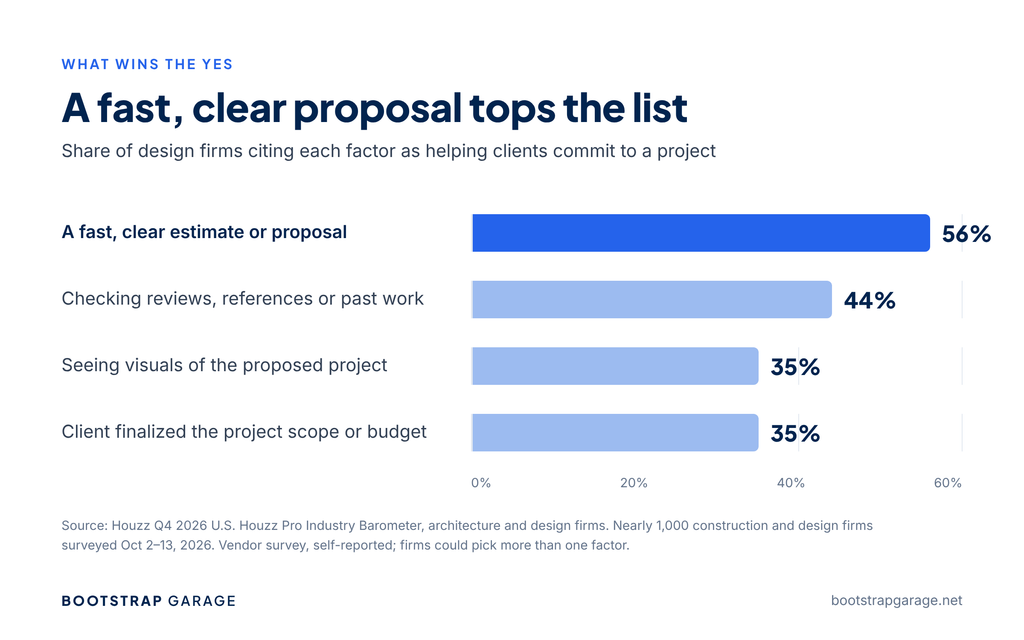
Houzz’s Q4 2026 Pro Industry Barometer surveyed about 1,000 construction and design firms in early October. When design firms were asked what helped clients commit to a project, the top answer, at 56%, was a fast, clear estimate or proposal. That beat checking reviews and references (44%) and seeing project visuals (35%) (Designers Today, October 22, 2026).
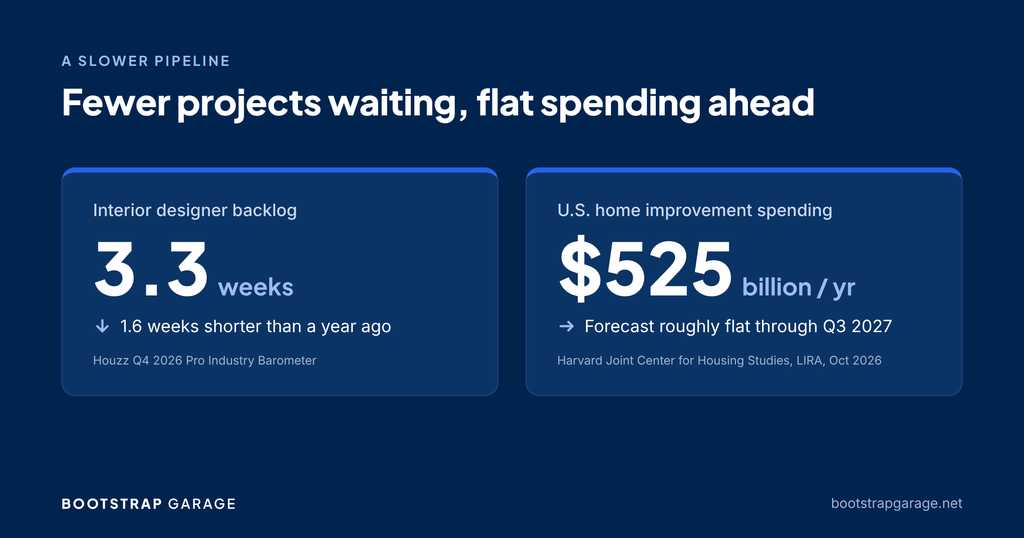
The same survey shows why this matters now. Design firms lowered their expected business activity index from 68 to 62, and interior designers’ backlogs shrank to about 3.3 weeks, 1.6 weeks shorter than a year ago. Sixty percent of design firms said clients were holding back because of the economy or their own finances. Harvard’s Joint Center for Housing Studies expects home improvement spending to stay roughly flat, around $525 billion a year, through the third quarter of 2027 (Qualified Remodeler, October 22, 2026).
To put it simply: fewer projects are in the pipeline, clients are cautious, and a slow proposal gives them one more reason to wait.
Think of it like a mechanic’s quote: When your car needs work, you call two shops. One sends a clear, itemized quote the same afternoon. The other says it will get back to you and sends a vague number four days later. Even if the second shop is a little cheaper, most of us have already booked the first one. Your clients make the same call about a kitchen or a living room, with far more money at stake.
What usually delays the proposal
In a small firm, a proposal tends to stall in a few predictable places:
- Site visit notes live in someone’s phone or notebook.
- Pricing is rebuilt from scratch every time (like re-checking supplier prices for the same tile).
- The proposal is copied from an old job and edited by hand.
- Nobody owns the follow-up once it is sent.
How to fix the problem
You probably don’t need new software. Most estimating, project management and accounting tools (QuickBooks estimates, for example) already include templates and item libraries. Here is the order I propose:
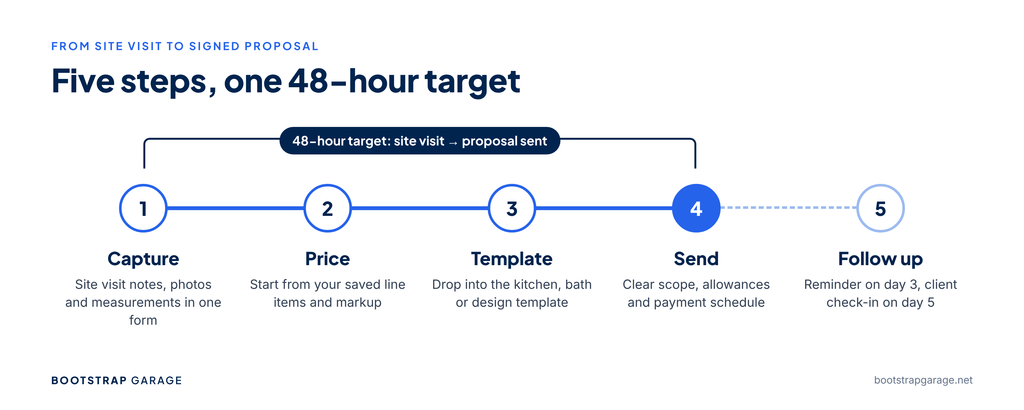
- Capture the site visit in one place: Use one form on a phone or tablet that feeds your CRM or project tool, with photos and measurements attached.
- Build a pricing library: Save your common line items with current supplier costs and your markup, so an estimate starts mostly done instead of blank.
- Use two or three proposal templates: One per project type (kitchen, bath, whole-floor design), with your scope language, exclusions and payment schedule already written.
- Set a turnaround goal and track it: Pick a target, such as 48 hours from site visit to proposal, and record the actual time for every job.
- Automate the follow-up: A reminder to you on day three and a short check-in email to the client on day five, so no proposal goes quiet.
However, speed without clarity backfires. A fast proposal with a vague scope or missing allowances invites change-order arguments later. The goal is a clear proposal sooner, not a sloppy one faster.
Say your firm sends 10 proposals a month and wins three. If cutting four days from your turnaround helped you win one more project a month, at an average of $40,000, that would add $480,000 in annual revenue. This is a hypothetical, your numbers will differ, and nobody can promise a win rate. It shows why proposal time is worth measuring.
In a slow market, I’d fix the proposal process before increasing ad spend. More leads pushed into a slow process just means more clients waiting. If your proposals already go out within two days and your win rate is still low, the problem is more likely pricing or fit, and I’d look there instead.
Book a 30-minute proposal review with me. Bring your last three proposals with the site visit date and send date for each. You’ll leave with your average turnaround, the step slowing it most, and what to fix first with the tools you already have.